
Imaging for hip pain
Hip pain has many possible sources: the hip joint itself, the lumbar spine referring pain to the buttock, the sacroiliac joint, the trochanteric bursa on the outside of the hip, and surrounding tendons. Imaging starts with X-ray; MRI is added when soft tissue or early arthritis is the question.
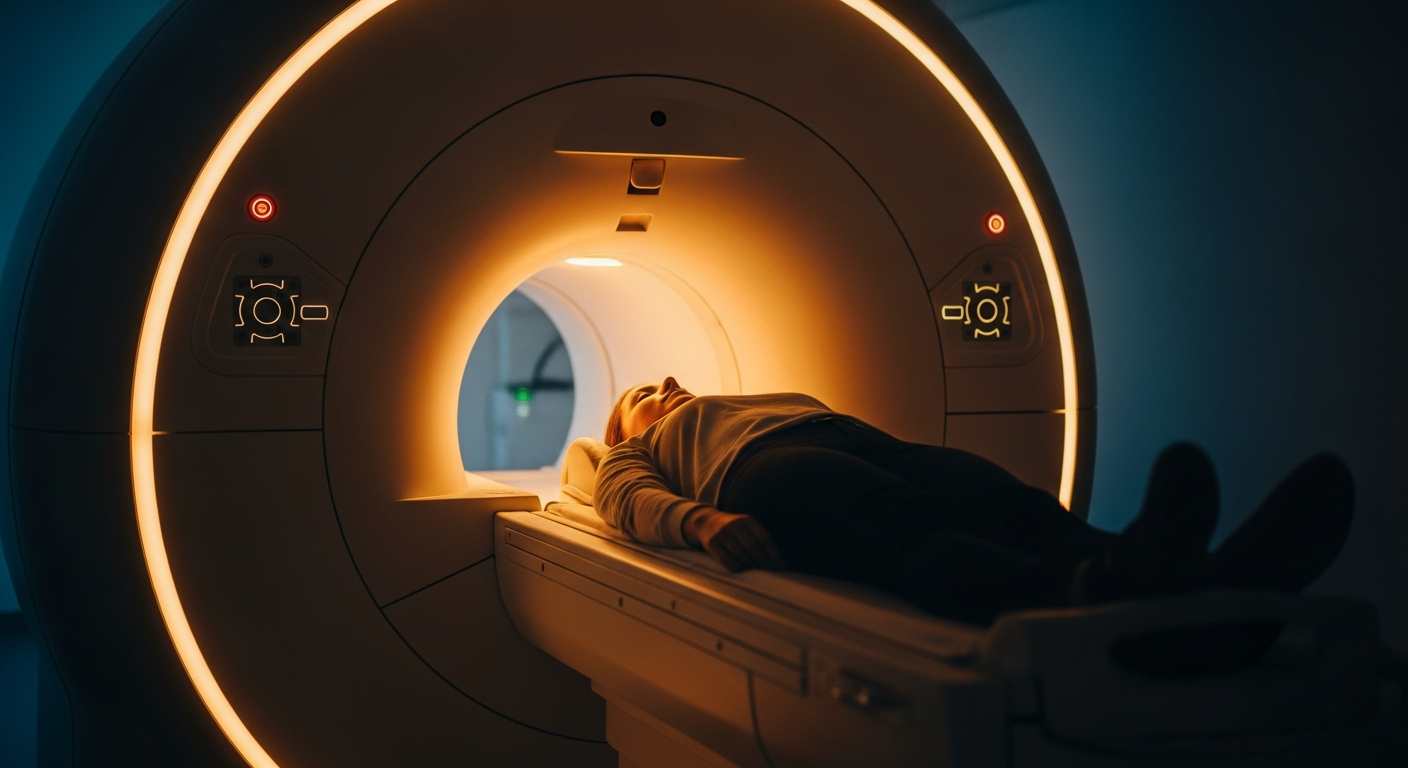
When hip pain does and doesn't need imaging
Many cases of mild hip pain without trauma respond to activity modification, stretching, and anti-inflammatories. Imaging is appropriate when:
- There is a history of trauma
- Pain is severe, persistent beyond four to six weeks, or wakes you from sleep
- There is a history of corticosteroid use, alcohol use disorder, or sickle cell disease (risk for avascular necrosis)
- There is concern for cancer, infection, or stress fracture in an athlete
- Pain limits weight-bearing
For older adults with a sudden inability to bear weight after even minor trauma, X-ray plus MRI may be needed because some hip fractures are not visible on X-ray alone — a missed occult femoral neck fracture is a recognized failure mode that MRI prevents.
Which scan for which problem
Hip X-ray is the first study. AP pelvis and dedicated hip views show alignment, joint space, fractures, and femoral head shape.
Hip MRI evaluates cartilage, labrum, marrow, surrounding tendons (gluteus medius/minimus), and bursae. It's the test of choice for suspected avascular necrosis, stress fracture, labral tear, or unexplained pain after a normal X-ray.
Hip CT is used when MRI is contraindicated or when complex bony detail is needed for surgical planning.
MR arthrogram of the hip is the gold standard for evaluating labral tears, femoroacetabular impingement, and cartilage damage in young adults with hip pain.
What the recommended scan shows
Hip MRI evaluates:
- The femoral head and neck for avascular necrosis, fracture, or marrow lesions
- The acetabular cartilage and labrum (best with arthrography)
- Gluteus medius and minimus tendons (the 'rotator cuff of the hip')
- The greater and ischial trochanteric bursae
- The sacroiliac joints for sacroiliitis
- The iliopsoas and adductor muscles for strain or tear
Common diagnoses and what they mean
Osteoarthritis — joint space narrowing and bone spurs. Common cause of groin pain in older adults.
Femoroacetabular impingement (FAI) — abnormal bony contact between femur and acetabulum, often associated with labral tear in young adults.
Labral tear — tear in the cartilage ring around the socket; may cause clicking, catching, or groin pain.
Avascular necrosis (osteonecrosis) — loss of blood supply to the femoral head; early diagnosis on MRI is critical because early-stage AVN can sometimes be saved.
Greater trochanteric pain syndrome — pain over the outside of the hip; usually gluteus medius/minimus tendinopathy with or without bursitis.
Occult or stress fracture — common in older adults after low-energy trauma and in athletes with sudden training increases.
What happens after results
Reports return within a day. Most hip problems are managed nonoperatively with physical therapy, activity modification, and selective injections. Surgical options range from hip arthroscopy (labral repair, FAI) to hip replacement for end-stage arthritis. Early avascular necrosis warrants prompt orthopedic referral.
How to get the scan at Precise
Bring your physician's order and ID. Hip MRI takes about 30 minutes; arthrography adds 30 minutes. Call 800-558-2223 for a transparent self-pay quote.
Frequently asked questions
How to schedule at Precise
Once you and your physician decide imaging is the right next step, scheduling is quick. Bring your prescription, photo ID, and insurance card.
Condition overview
Learn more about the specific conditions associated with this symptom — what imaging is used, what it shows, and how to schedule at Precise.
Find imaging near you
Precise Imaging has locations across California with same-day scheduling, board-certified radiologist reads, and transparent pricing.