
Imaging for persistent headache
Most headaches do not need imaging. Tension-type headaches, classic migraine, and cluster headache are usually diagnosed clinically. Imaging becomes important when red-flag features are present or when headache pattern changes meaningfully. This guide explains which scan to expect and what neuroimaging can and cannot answer.
When headache does and doesn't need imaging
The Choosing Wisely campaign and ACR Appropriateness Criteria converge on a clear theme: routine imaging for stable migraine is low-value. Imaging is appropriate when one of these features is present:
- 'Thunderclap' headache — peaks within seconds (rule out subarachnoid hemorrhage; CT is the immediate test)
- New headache after age 50
- Headache that progressively worsens over days to weeks
- Focal neurologic deficit, visual changes, weakness, or cognitive change
- Headache with seizure, syncope, or behavior change
- New headache pattern in a patient with cancer or immunosuppression
- Headache that wakes you from sleep, worsens with Valsalva, or worsens with positional change
- Fever and stiff neck (suggests meningitis — emergency)
For sudden 'worst headache of life,' go directly to an emergency department.
Which scan for which problem
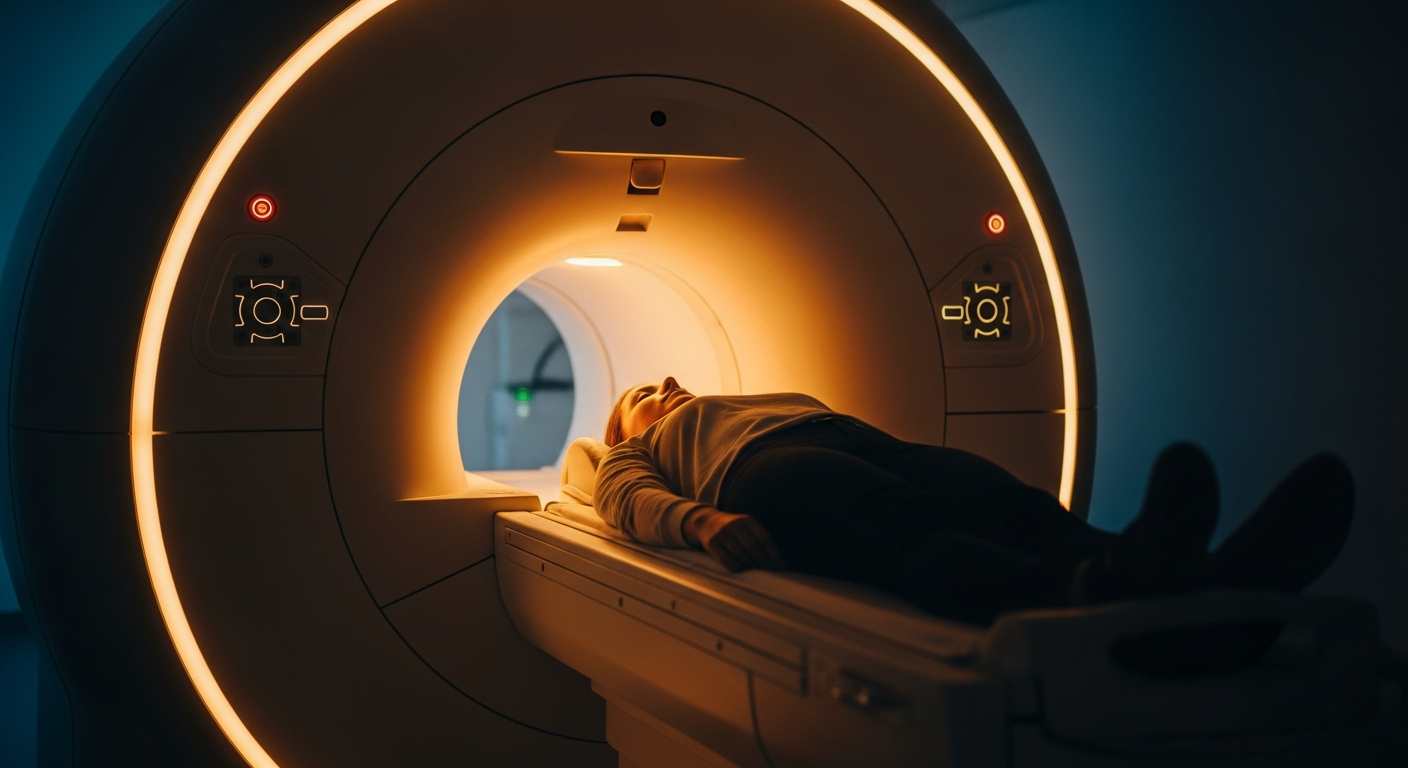
Brain MRI is the test of choice for evaluating most chronic headaches that warrant imaging. It evaluates the brain parenchyma, cerebrospinal fluid spaces, vessels (with appropriate sequences), and the skull base. It uses no ionizing radiation.
Head CT is the right test in the acute setting — particularly for thunderclap headache, recent trauma, or suspected hemorrhage. CT is faster and widely available in emergency departments. For most non-emergent outpatient headache evaluation, MRI is preferred because of higher sensitivity and no radiation.
CT with contrast is used in selected cases (e.g., suspicion of certain tumors when MRI is contraindicated).
What the recommended scan shows
A brain MRI evaluates:
- The brain parenchyma for stroke, tumor, demyelination (e.g., MS), or infection
- The ventricles for hydrocephalus or signs of increased pressure
- The pituitary and sella for adenoma
- The cerebellum and brainstem for posterior fossa lesions
- The skull base, sinuses, and mastoids for inflammatory disease
- Old strokes, microbleeds, and white matter changes
Small nonspecific white matter changes are extremely common with age and migraine. The radiology report will clarify whether findings are likely incidental or warrant further evaluation.
Common diagnoses and what they mean
Migraine — typically diagnosed clinically. MRI is usually normal but may show small white matter changes more often than in non-migraineurs.
Tension-type headache — diagnosed clinically; imaging is generally normal.
Sinus disease — inflammatory changes in paranasal sinuses can cause facial pain mistaken for headache.
Tumor — uncommon as a cause of isolated chronic headache; more often presents with progressive symptoms or focal deficit.
Idiopathic intracranial hypertension — elevated CSF pressure, typically in young women, with characteristic MRI features.
Cervicogenic headache — referred from the upper cervical spine; cervical spine imaging sometimes helps.
What happens after results
Reports are usually available within a day. Most patients with imaging for chronic headache have a normal or near-normal MRI, which is reassuring. When a meaningful finding is present, your physician will discuss next steps — referral to neurology, neurosurgery, or further imaging.
How to get the scan at Precise
Bring your physician's order. Brain MRI usually takes about 25 to 35 minutes and most outpatient studies are performed without contrast. See our brain MRI page for locations, and call 800-558-2223 for a transparent self-pay quote.
Frequently asked questions
How to schedule at Precise
Once you and your physician decide imaging is the right next step, scheduling is quick. Bring your prescription, photo ID, and insurance card.
Condition overview
Learn more about the specific conditions associated with this symptom — what imaging is used, what it shows, and how to schedule at Precise.
Find imaging near you
Precise Imaging has locations across California with same-day scheduling, board-certified radiologist reads, and transparent pricing.