
Open vs Closed MRI — Which Is Right for You?
An honest comparison of Open MRI and closed (high-field) MRI — image quality, comfort, who each is best suited for, and what Precise Imaging offers at each site.
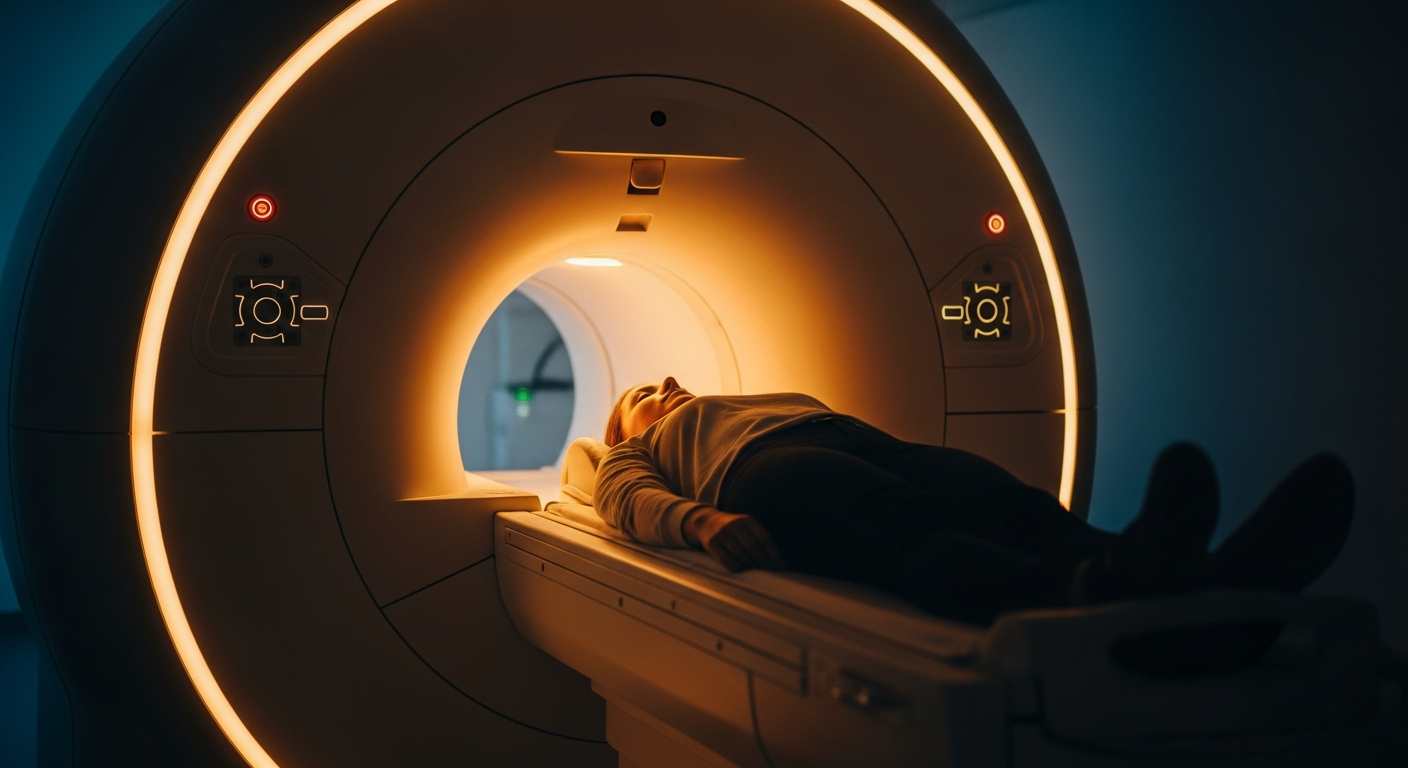
Most MRI machines fall into two broad designs: a traditional closed (high-field) scanner with a tunnel-shaped bore, and an Open MRI with sides that are partially or fully open. Both produce diagnostic images, but the trade-offs matter.
TL;DR comparison
| Feature | Open MRI | Closed (high-field) MRI |
|---|---|---|
| Design | Open sides, wider opening, no full tunnel | Tunnel-shaped bore (now typically wide-bore) |
| Magnet strength at Precise | 0.7T – 1.2T | 1.5T or 3T |
| Image detail | Good for many studies; less detailed for fine structures | Higher signal-to-noise; sharper detail, thinner slices |
| Typical scan time | Slightly longer | Often shorter for similar protocols |
| Weight limit | Higher — up to 500 lb on some systems | Typically 400–550 lb depending on bore size |
| Best for | Claustrophobic, pediatric, larger-body patients | Brain, spine, MSK, body imaging where detail matters |
| Available at Precise | Yes, at select locations | Yes, at every MRI location |
How each design works
A closed MRI surrounds you with a uniform, high-strength magnet — typically 1.5T or 3T at Precise. The uniformity of that field is what gives high-field MRI its sharp images and shorter scan times. Modern systems are "wide-bore," meaning the tunnel is roomier than older models.
An Open MRI uses a lower-strength magnet (commonly 0.7T to 1.2T) arranged so that the patient is not enclosed in a tube. The trade-off is reduced signal-to-noise — meaning detail is somewhat lower and scans can take slightly longer to acquire equivalent images.
When Open MRI is preferred
- Significant claustrophobia or anxiety in enclosed spaces
- Larger patients who exceed weight or bore limits of standard machines
- Pediatric patients who do better with a caregiver visible nearby
- Patients with limited ability to lie flat for long periods
- Routine MSK studies where high-field detail is not required
When closed (high-field) MRI is preferred
- Brain, spinal cord, and cranial nerve imaging
- Detailed musculoskeletal exams (small joints, labrum, cartilage)
- Contrast-enhanced studies needing tight slice resolution
- Body imaging (liver, prostate, breast) where small-lesion detection matters
- Any study where the radiologist has specified "1.5T or higher"
Safety, comfort, and image quality
Radiation. Neither uses ionizing radiation — both are equally safe in that regard.
Image quality. A 3T or 1.5T closed MRI generally produces sharper, more detailed images than a lower-field Open MRI. For many studies (knee meniscus, lumbar disc, brain), high-field is preferred because the radiologist can detect subtle findings.
Comfort. Open MRI is the better choice if you can't tolerate enclosed spaces. If you'd prefer high-field detail but worry about the tunnel, ask about our wide-bore 3T systems, which feel noticeably roomier than older machines, plus headphones, music, and a panic button.
Speed and noise. Closed MRI scans are often faster per sequence. Both designs are loud — you'll get hearing protection at any Precise site.
Implants and contraindications. The same MR-safety screening applies to both designs. Some implants are conditional at 1.5T but not at 3T (or vice versa); our technologists confirm before you enter the suite.
How to decide with your doctor
The right choice depends on what is being imaged, how detailed the study needs to be, and what you can comfortably tolerate.
- Ask your referring provider whether the read requires high-field (1.5T or 3T). For brain, small-joint, and contrast-enhanced exams the answer is usually yes.
- Tell our schedulers about claustrophobia, body habitus, or mobility limits — we can route you to the right system.
- Try a wide-bore 3T first if you're borderline claustrophobic. Many patients who expected to need Open MRI are comfortable in our wide-bore systems.
- Consider sedation if needed — your physician can prescribe a single oral dose for the appointment.
Ready to schedule? See MRI services and locations, or call 800-558-2223 to find the nearest site with Open MRI or wide-bore 3T availability.
Frequently asked questions
Is image quality worse on an Open MRI?+
Open MRI typically uses a lower-strength magnet (around 0.7–1.2T) and generally produces slightly less detailed images than a 1.5T or 3T closed MRI. For most musculoskeletal studies it is fully diagnostic; for brain, contrast-enhanced, and small-joint studies a high-field closed MRI is usually preferred.
Can I get an Open MRI if I'm claustrophobic?+
Yes — Open MRI is one of the best options for significant claustrophobia. Many patients also do well in our wide-bore 3T systems, which are noticeably roomier than older closed scanners. We can talk through both options when you schedule.
Is there a weight limit on Open MRI?+
Open MRI systems generally have a higher weight limit than older closed scanners — up to about 500 lb on some systems. Modern wide-bore closed MRIs at Precise also handle up to roughly 400–550 lb depending on the system. Our schedulers can confirm the limit at the specific site you'd like to book.
Does Open MRI take longer?+
Slightly longer in many cases. Because the magnet is weaker, more averaging is needed to produce a comparable image. A typical Open MRI runs 30–50 minutes versus 20–45 minutes on a closed system.
Is Open MRI more expensive?+
Insurance reimbursement and self-pay rates are generally similar between Open and closed MRI at Precise. We don't upcharge for one design over the other.
Will my doctor accept an Open MRI result?+
For most general MSK and routine spine indications, yes. For neuro, prostate, breast, or small-joint studies, your physician may specifically request a 1.5T or 3T closed MRI. Ask before scheduling if you're unsure.