MRI With or Without Contrast — What's the Difference?
A plain-language guide to gadolinium contrast for MRI — when it's needed, how it works, safety considerations, and what to expect on the day of your scan.
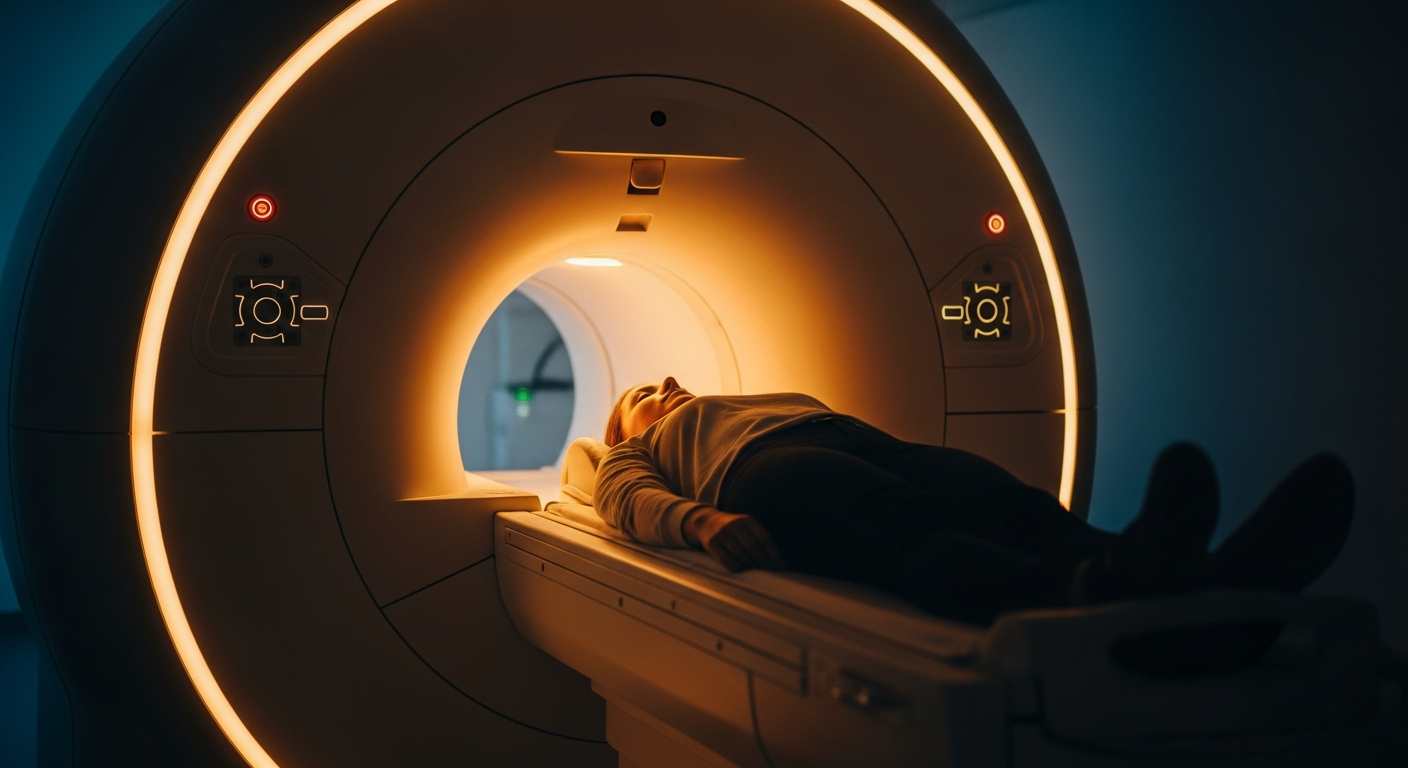
When your physician orders an MRI, the order will specify with contrast, without contrast, or with and without contrast. Each version answers different questions, and the prep is slightly different.
TL;DR comparison
| Feature | MRI without contrast | MRI with contrast |
|---|---|---|
| Uses an IV injection? | No | Yes — gadolinium-based |
| Typical scan time | 20–35 minutes | 30–60 minutes |
| Best at showing | Anatomy, structural injuries, basic pathology | Active inflammation, tumors, infection, vascular structures |
| Fasting required | Generally no | Yes — usually 4 hours for solids |
| Kidney function check | Not required | Required (recent eGFR) |
| Allergy considerations | Minimal | Gadolinium allergy is rare but screened |
| Cost | Lower | Higher (contrast adds a charge) |
| Available at Precise | Yes | Yes — at all locations |
How each study works
Without contrast. The scanner generates images purely from how tissues respond to the magnetic field and radio waves. This shows you anatomy, fluid, fat, edema, and structural injury in beautiful detail — and it's the right test for most musculoskeletal, brain, and spine questions.
With contrast. A gadolinium-based contrast agent is injected through an IV. Gadolinium changes how nearby water molecules behave, making vascular structures, areas of active inflammation, tumors, and infection light up dramatically against surrounding tissue. The radiologist acquires "pre-contrast" sequences first, then "post-contrast" sequences after the injection.
When contrast is needed
- Suspected or known tumor — to characterize, stage, and assess vascularity
- Suspected infection or abscess — contrast highlights inflammatory rim enhancement
- Multiple sclerosis follow-up — active vs old lesions
- Vascular imaging (MRA, MRV) — vessel anatomy and abnormalities
- Post-operative spine or joint — to distinguish scar tissue from recurrent disc/tumor
- Pituitary, internal auditory canal, and cranial nerve studies
- Pelvic, prostate, breast, or liver imaging when characterizing a lesion
When contrast is not needed
- Routine spine MRI for back pain without red-flag symptoms
- Most MSK studies for ligament, meniscus, or tendon injury
- Acute stroke (usually CT first; non-contrast MRI thereafter)
- Pre-employment or screening exams
- Initial brain MRI for seizure or headache work-up (often)
Safety, speed, and cost differences
Radiation. Neither uses ionizing radiation.
Kidney function. Gadolinium is excreted by the kidneys. If your kidney function is impaired (low eGFR), your physician and our radiologist will weigh the benefit of contrast against the small risk of a rare reaction called nephrogenic systemic fibrosis. Modern macrocyclic gadolinium agents — which Precise uses — have a very low risk profile. We require a recent creatinine/eGFR result for adult patients receiving contrast.
Allergy. True gadolinium allergy is uncommon (much less common than iodinated CT contrast). Reactions are usually mild (itching, hives) and are treated immediately. If you've had a prior reaction, tell us — we can pre-medicate or switch agents.
Pregnancy. Gadolinium is generally avoided during pregnancy unless clearly indicated. If you are or might be pregnant, tell us before the scan.
Cost. Contrast adds a charge for the agent and the IV start. Both insurance and self-pay rates differ between with- and without-contrast studies; our schedulers can quote either before you commit.
Speed and prep. With-contrast scans run longer because the radiologist needs both pre- and post-contrast sequences. Most centers ask you to fast 4 hours for solids; clear liquids and most medications are usually fine.
How to decide with your doctor
You don't choose this yourself — the referring physician specifies the protocol when they write the order. If the order is ambiguous, our radiologist will call back to clarify before your appointment. A few practical notes:
- Bring your order or referral to check-in so we run the exact protocol your physician requested.
- Tell us about kidney disease, prior reactions, or pregnancy when you schedule.
- Bring prior imaging on CD if available — the radiologist may use it to decide whether contrast is still needed.
- Plan for the longer appointment if your order says "with and without."
To schedule, see MRI services and locations or call 800-558-2223. For prep details on day-of-scan logistics, see Preparing for Your High-Field 3T MRI Scan.
Frequently asked questions
Is MRI contrast (gadolinium) safe?+
Modern macrocyclic gadolinium agents — which Precise uses — have a very low risk profile for patients with normal kidney function. Reactions are uncommon and usually mild. We screen kidney function (eGFR) for adult patients before any contrast-enhanced study.
Why does my doctor want MRI 'with and without contrast'?+
Some protocols require both pre-contrast and post-contrast sequences so the radiologist can directly compare enhancement patterns — common for tumor, infection, MS follow-up, and post-surgical spine or joint imaging.
Do I need to fast before a contrast MRI?+
Most centers ask you to fast 4 hours from solid food. Clear liquids and most prescription medications are typically fine. Your scheduler will give you exact instructions when you book.
Can I get an MRI with contrast if I have kidney disease?+
Maybe — it depends on your eGFR and the clinical question. Our radiologists weigh the benefit against the risk of a rare reaction called nephrogenic systemic fibrosis. If contrast is not appropriate, we can often switch to a non-contrast protocol or another modality.
Is gadolinium contrast safe during pregnancy?+
Gadolinium is generally avoided during pregnancy unless clearly indicated. Tell us before scheduling if you are or might be pregnant, and your physician and our radiologist will discuss alternatives.
Does contrast make the MRI take longer?+
Yes — typically 15–25 additional minutes for the IV placement, pre- and post-contrast sequences, and brief observation afterward.